Klaviyo and ecommerce SEO, built to be measured.
I am an independent Klaviyo expert and ecommerce SEO consultant. I run lifecycle email and organic search for DTC brands, and white-label execution for agencies who need the work done quietly and properly. Eleven years in, one rule: the numbers I report are the numbers you can check.
Book a call
30 min · no pitch- Thirty minutes, your calendar, no deck.
- Bring the account or the site. I will tell you what I would change first.
- If it is not a fit, I will say so on the call.
Live booking loads inline on the published site. This panel is the fallback.
100%
Job success score
4.9
Across 18 reviews
26
Contracts delivered
1,800+
Hours billed
Six disciplines. No development, no ads, no social.
Narrow on purpose. If a brief sits outside this, I will tell you before we start rather than learn it on your budget.
Klaviyo lifecycle email
Flow architecture, segmentation and the campaign calendar. Conversion-based exits, re-entry rules and suppression handled so the programme stops fighting itself.
- Flows
- Segments
- Deliverability
- Klaviyo audit
Email marketing strategy
The layer above the platform. Audience research and segmentation, offer and subject-line split testing, send-time and frequency optimisation, and reporting that separates what worked from what merely happened.
- Audience research
- Split testing
- Automation
- Optimisation
HubSpot management
Consultation, onboarding and ongoing management across Marketing, Sales, Service and Operations Hub. Workflows, lifecycle stages, properties, pipelines and dashboards, set up so the team actually uses them.
- Onboarding
- Workflows
- Reporting
- No development
Ecommerce SEO
Technical and on-page at scale. Crawl budget, faceted navigation, internal link equity and the indexation problems that quietly cap a catalogue.
- Technical
- On-page
- Content
- Crawl budget
AI search visibility
Getting a brand cited inside ChatGPT, Google AI Overviews, AI Mode, Gemini, Perplexity and Copilot. Tracked month to month in Brand Radar, not spot-checked and hoped for.
- GEO
- Entity work
- Citations
- Brand Radar
White-label for agencies
Execution capacity under your name. Production, publishing and manual link building from documented SOPs, so quality holds at volume and there is little to manage.
- Link building
- Production
- Publishing
- Discreet
Stack
Klaviyo · HubSpot · Shopify · WooCommerce · Ahrefs and Brand Radar · Google Search Console · GA4 · Screaming Frog · Pitchbox · BuzzStream
Disciplines
Lifecycle email · Ecommerce SEO · Generative engine optimisation · Backlink building and digital PR · Technical audits · Marketing automation
Certified
HubSpot Inbound, Digital Marketing and Reporting certifications, all current and verifiable below.
Current, verifiable, with the codes attached.
Each one carries a certification code you can check against HubSpot Academy. Nothing here expires before 2027.
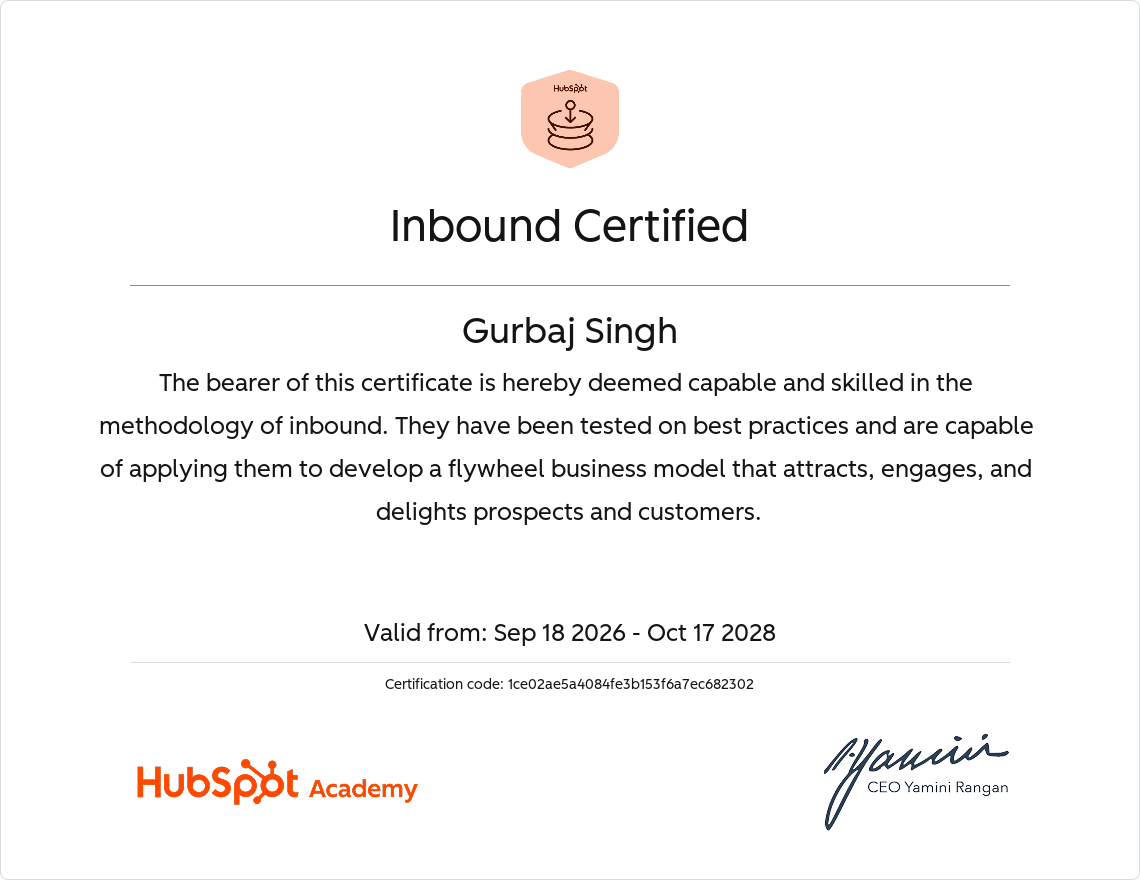
HubSpot Academy
Inbound Certified
- Issued
- 18 Sep 2026
- Valid to
- 17 Oct 2028
- Code
- 1ce02ae5a4084fe3b153f6a7ec682302

HubSpot Academy
Digital Marketing Certified
- Issued
- 18 Sep 2026
- Valid to
- 17 Oct 2028
- Code
- bf23ecc42c52459586f6714eb8aeec5a
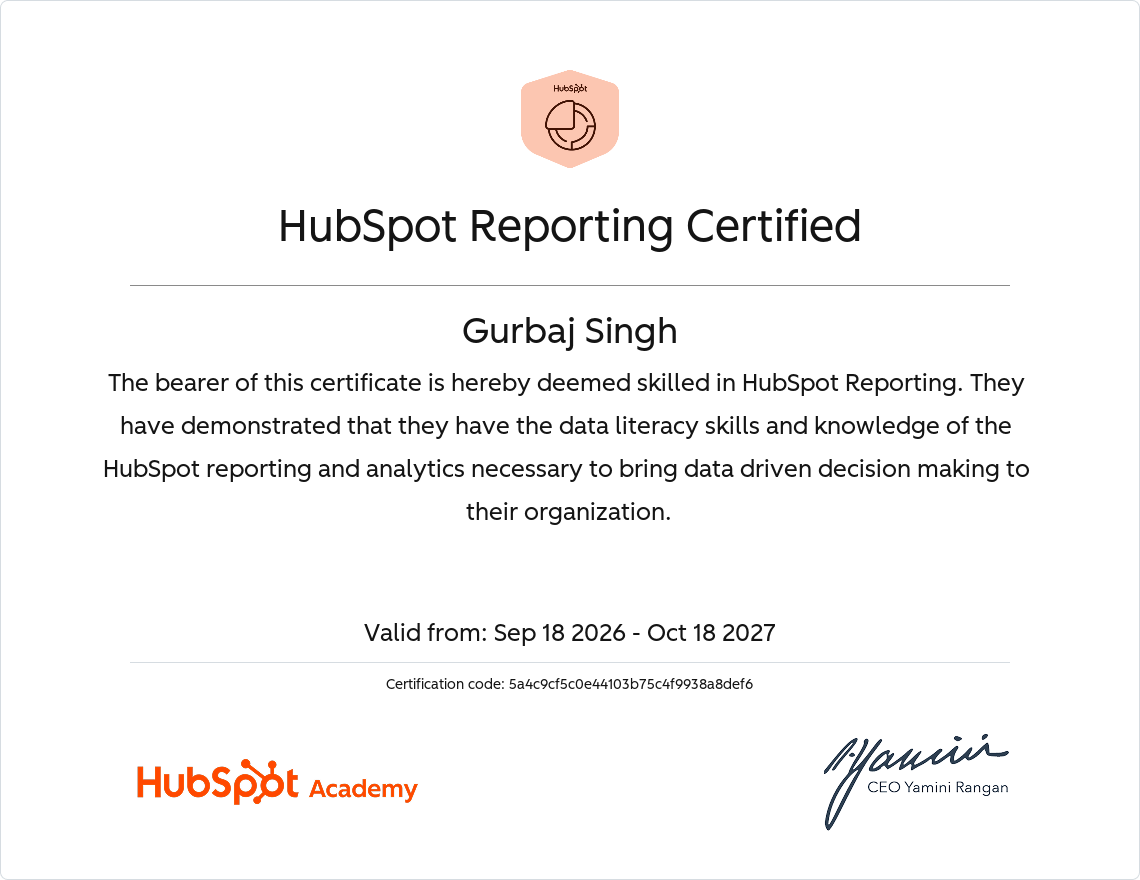
HubSpot Academy
HubSpot Reporting Certified
- Issued
- 18 Sep 2026
- Valid to
- 18 Oct 2027
- Code
- 5a4c9cf5c0e44103b75c4f9938a8def6
Three flows, why each one exists, and what it earns.
Mapped from a live Klaviyo account, not drawn from a template. Revenue figures are the last 30 days on the conversion metric the account uses.
Why it exists
Someone looks at a product and leaves. Most of them are not ready yet, and a single generic reminder treats a first-time visitor and a five-time buyer as if they were the same person.
The problem it solved
The store was handing first-order discount pricing to customers who had already bought several times. That is margin given away on revenue the store would have earned anyway. It was invisible because the flow reported positive revenue either way.
What changed
The offer now sits behind two gates: the person has never placed an order, and the item they viewed is one the margin supports. Everyone else exits after the second email. The final send runs as an A/B test with UTM tracking, and smart sending stops a person in three flows receiving three emails in a day.
Results, last 30 days
$4,147
Attributed revenue from this flow alone
- Per recipient
- $6.40
- Emails in flow
- 3
- Conditional splits
- 2, nested
- Span
- 3 days
Why it exists
A failed card is the only kind of abandoned checkout where the customer has already decided to buy. Nothing needs to be sold. Something needs to be fixed, quickly, before the intent fades.
The problem it solved
Two problems. It was running on a default template nobody owned, so the retry link was buried. And it was classed as marketing, which meant it could not legally reach anyone who had unsubscribed from marketing email. On an established list that is a large share of past buyers: the exact people most likely to be mid-purchase.
What changed
Fifteen minute delay, because a card problem can often still be fixed while the person is at their desk. Reclassified as transactional, so it reaches unsubscribed customers, which is both permitted and the entire point. One email. Nothing else.
Results, last 30 days
$30.01
Revenue per recipient, the highest in the account
- Total revenue
- $2,400.63
- Emails in flow
- 1
- Delay
- 15 minutes
- Classification
- Transactional
Why it exists
Browse abandonment only fires when someone opens a product page. A large share of visitors land, read a guide or a comparison, form an opinion, and leave without ever touching a product URL.
The problem it solved
That traffic was invisible to every flow in the account. The store was paying to acquire readers and then had no mechanism to follow up with any of them, because none of the existing triggers could see them.
What changed
It triggers on Active on Site rather than a product view, then immediately checks whether the person has ordered since entering and exits them if so, which keeps it away from customers mid-purchase. Three emails over three days: a reminder, a decision guide for people still comparing, and a final note that is A/B tested.
Results, last 30 days
$15.33
Revenue per recipient on an early sample
- Total revenue
- $137.95
- Emails in flow
- 3
- Purchase gate
- Before email 1
- Status
- Rebuilt this week
Email, search and AI visibility, kept separate.
Three disciplines, three kinds of proof. These are agency engagements, so the clients are not named. Figures come from Ahrefs in September 2026.
B2B SaaS · AI search
Cited across six AI engines
- AI citations
- 325
- Cited pages
- 184
- Perplexity citations
- 96
- ChatGPT citations
- 34
- Keywords in top 3
- 479
B2B security · SEO
High-value commercial terms
- Organic traffic
- 859 / mo
- Traffic value, Ahrefs est.
- $3,493 / mo
- Keywords in top 3
- 53
- Ranking keywords
- 165
- AI citations
- 56
Vehicle retail · GEO
Small site, outsized AI presence
- AI citations
- 103
- Cited pages
- 42
- Keywords in top 3
- 85 of 167
- AI Mode citations
- 26
- Perplexity citations
- 21
A DTC brand, three disciplines, one operator.
One account, three disciplines.
I own the email program, the SEO and content program, and the AI-search visibility work. The email side runs seventeen live flows alongside a weekly campaign calendar: a winback series split four ways by product family so a lapsed buyer hears about what they actually bought, a payment-recovery flow that pulled back roughly $47K on its own, and segmentation that separates engaged buyers from the rest of the list.
On the search side I built this brand's AI visibility from nothing. It is now cited in ChatGPT, surfaces in Google AI Overviews and appears in Perplexity, tracked month to month in Ahrefs Brand Radar rather than spot-checked and hoped for.
At a glance
- Attributed revenue
- $1.3M / 12mo
- Campaigns sent
- 158
- Live flows
- 17
- Open rate
- 28.8 to 34.3%
- Payment recovery
- ~$47K
- List size
- ~37,800
- Cited in AI
- 3 engines
† Attributed revenue as the platform reports it, not incremental. The two are not the same, and most reports do not say which they mean.
The part most people find out three months in.
01
I tell you what the data says
Including when it says the thing you paid for is not working. Attributed and incremental get separated. Metrics that flatter get flagged. You will never learn about a problem from a dashboard before you hear it from me.
02
I work from documented SOPs
Vetting thresholds, pre-send checklists, publishing standards. Output stays consistent as volume rises, onboarding is quick, and there is very little to supervise.
03
I say no to the wrong brief
If a keyword cannot realistically be won, or a link target is not worth the money, I will say so before we start rather than bill you to find out. Scope I cannot deliver well, I turn down.
Eighteen reviews, all of them public.
100%
Job success score
4.9
Average of 18 reviews
26
Contracts delivered
1,800+
Hours billed
Verifiable on Upwork. Not self-reported.
Client reviews, including the four-star one.
Verbatim from the Upwork profile. A page that only shows fives is a page nobody believes.
★★★★★
HubSpot · 5.0 · 2023
"It was excellent working with Gurbaj. He went above and beyond. He was able to quickly understand the needs and execute things fast. I will totally recommend Gurbaj for any marketing or Hubspot related gigs."
HubSpot trainer, Marketing, Sales, Service and Ops Hub
★★★★★
SEO · 5.0 · 2020
"Gurbaj is an incredible communicator and sees and understands the bigger picture. His desire to work hard and provide honest work to his clients. My profession is to build a team of people for companies. I understand what makes good employees and Gurbaj has all those qualities. I would highly recommend him for any project."
SEO retainer
★★★★☆
Content · 4.8 · 2022
"This is the second time we worked together. It was a pleasant experience, even though some small parts weren't perfect, Gurbaj fixed it all. I am certain we'll work again."
Blog content plan, repeat client
Asked often enough to answer here.
What does a Klaviyo expert actually do?
Three things, in the order that usually matters. Flow architecture, which is the automated email that runs whether or not anyone is at a desk. Segmentation, so the right people get the right message and the rest of the list is not burned. And deliverability, which decides whether any of it reaches an inbox at all. Campaign sending is the visible part and the smallest part. A good Klaviyo agency spends most of its time on the flows nobody sees.
What is a Klaviyo audit and what does it cover?
A structured review of an existing Klaviyo account: every live flow and where it leaks, list health and suppression, segment logic, deliverability signals, and whether the revenue the dashboard reports is attributed or incremental. The output is a prioritised list of what to fix first and what to leave alone, not a forty-page PDF. Most accounts have two or three fixes worth more than everything else combined, and a Klaviyo audit exists to find them.
How much does a Klaviyo consultant cost?
It depends on whether you want a fixed piece of work or ongoing ownership. An audit is a one-off fee. Building a flow programme from scratch is usually project-priced against a defined list of flows. Ongoing management is a monthly retainer sized to the campaign calendar and the number of live flows. I quote after seeing the account, because quoting before seeing it means either padding the number or discovering the problem on your budget.
What is generative engine optimisation, and is it different from SEO?
Generative engine optimisation, or GEO, is the work of getting a brand cited inside AI answers: ChatGPT, Google AI Overviews, Google AI Mode, Gemini, Perplexity and Copilot. It overlaps with SEO but it is not the same job. Classic SEO optimises for a ranked list of links. GEO optimises for being the source an answer is assembled from, which depends more on entity clarity, citation-worthy pages and third-party corroboration than on ranking position alone. It is measurable: citation counts per platform can be tracked month to month in Ahrefs Brand Radar.
Is answer engine optimisation the same as GEO?
Near enough that arguing about it wastes your time. Answer engine optimisation, or AEO, usually describes optimising for direct-answer surfaces including featured snippets and voice. GEO usually describes optimising for generative models that synthesise an answer from several sources. The practical work overlaps almost completely: clear entities, question-shaped content, structured data, and citations from places the models already trust.
What does ecommerce SEO actually include?
For a catalogue site, the technical layer usually matters more than the content layer. Crawl budget, so the crawler spends its time on pages that can rank rather than on filter permutations. Faceted navigation control. Internal link equity, so category pages are not starved. Indexation diagnosis, which is where most ecommerce SEO engagements should start. Then on-page at scale, and content that targets the terms with commercial intent rather than the ones with the biggest volume.
How long before ecommerce SEO shows results?
Technical fixes can move indexation within weeks, because you are removing a blocker rather than building authority. Rankings on commercial terms take longer, typically three to six months on an established domain and considerably longer on a new one. Anyone promising faster on a competitive term is either buying links or describing a keyword nobody searches.
Do you work white label for agencies?
Yes, and it is a large part of the work. Production, publishing and manual link building delivered under your name, from documented SOPs, with no contact with your client unless you want it. White label SEO services only work if the confidentiality runs both ways, so agency clients are never named here or anywhere else, and neither are their results without written permission.
Do you do HubSpot development?
No. I do HubSpot consultation, onboarding, management and automation across Marketing, Sales, Service and Operations Hub: workflows, lifecycle stages, lists, properties, pipelines, dashboards and reporting. Custom code, HubL theme development and API integrations are a developer's job and I will tell you that rather than take the work.
Which email platforms do you work with?
Klaviyo first, by a wide margin, and HubSpot for B2B lifecycle and marketing automation. The strategy layer travels between platforms: audience research, segmentation, split testing, send-time and frequency optimisation and honest reporting look much the same wherever they are executed. The platform-specific build is where the depth matters, and that is Klaviyo.
Do you work with brands outside ecommerce?
Some, on the search and AI-visibility side. B2B SaaS in particular, where the GEO work translates almost directly. The Klaviyo work is ecommerce by nature, because the flows depend on product and order events.
Where are you based and which hours do you work?
Mohali, India, working US hours. Most clients are in the United States and the overlap is deliberate rather than occasional.